

Your servers shouldn't need you awake for every deploy, fix, and renewal. FlatRun runs the routine work itself, on hardware you own, under the governance you set.

Isolated, persistent deployments from one interface, every config a plain file on your own machine. No per-site fees, no vendor lock-in, full data sovereignty.
Run your product on infrastructure you own. Ship from CI with standard Docker Compose, scale across nodes, and keep full API control as you grow.
Standardize how internal apps get deployed. Full API and CLI automation, role-based access, and complete data sovereignty on your own hardware.
Run every client site from one panel: one-click deploys, staging environments, and white-label hosting, with no per-site or per-domain fees.
Resell hosting and keep the margin. Cluster nodes, manage hundreds of sites, and automate through the API and CLI, with no per-account license tax.
A clean, modern interface for managing all your deployments

Full container control with logs, shell access, and file management
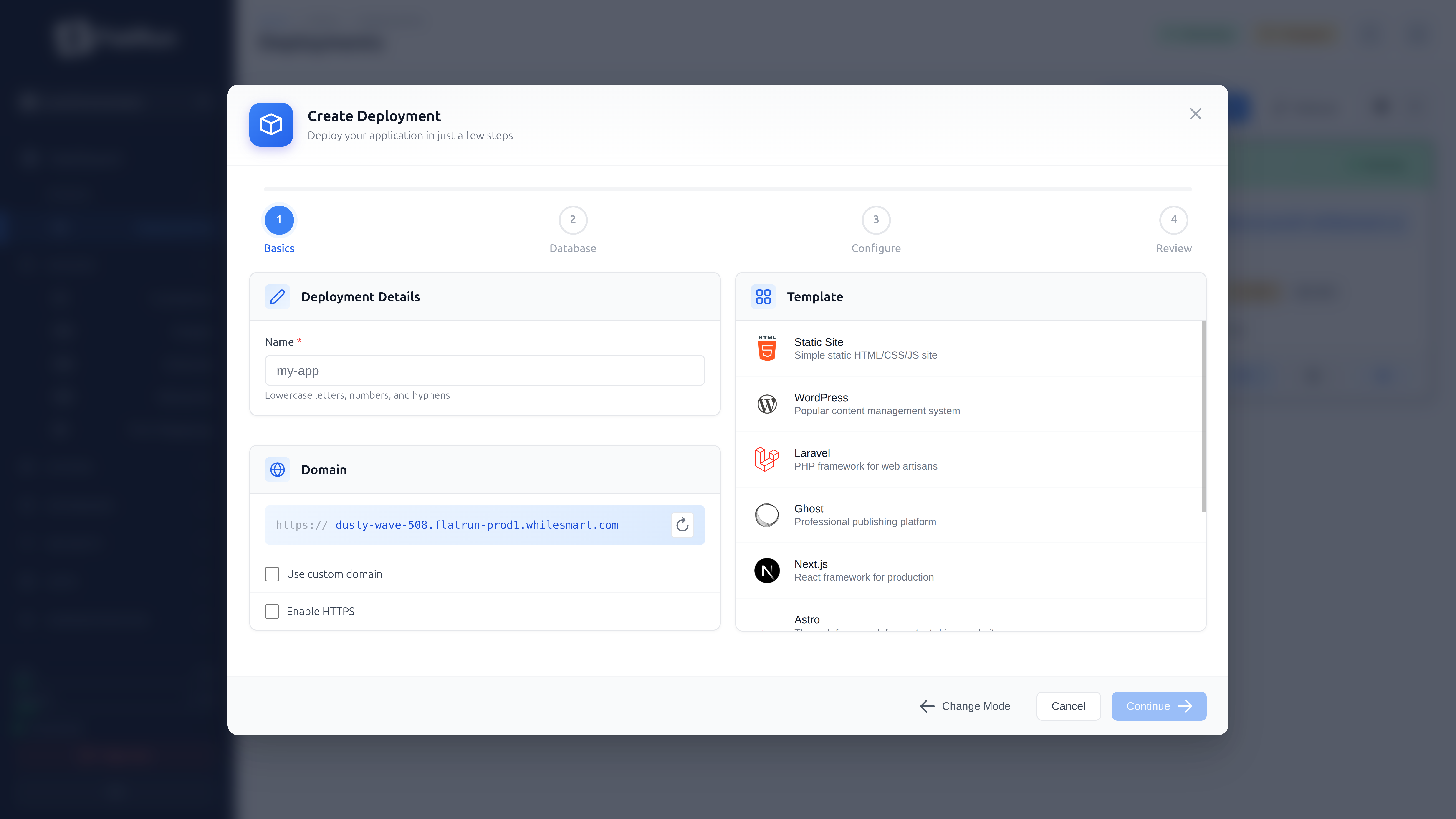
Deploy containers in seconds, from templates or your own image
Everything a deployment platform should do, running on infrastructure you control.
No database required. Everything stored as files—backup with cp, version control with git.
Built on Docker from day one. Standard compose files, portable containers, zero vendor lock-in.
WordPress, Node.js, Python, and more—live in seconds with pre-configured templates.
Create databases, manage users, run queries. MySQL, MariaDB, and PostgreSQL built-in.
Point domains to containers with automatic Nginx configuration. No manual config files.
Track certificate expiration dates and get alerts before your sites go down.
Monitor CPU, memory, and disk across all sites. Identify issues before they become problems.
Automate everything. Integrate FlatRun into your existing tools and workflows.
Browse, edit, upload files directly from the browser. No FTP setup required.
Stream container logs in real-time with filtering, search, and download.
Open terminal sessions to containers directly from your browser.
Self-hosted by design. Your data stays on your servers, in your jurisdiction. GDPR-ready out of the box.
A built-in assistant inspects deployments, logs, and config, proposes fixes, and carries them out under the governance you set: what runs freely, what needs your sign-off, what never runs. The same tools are exposed over MCP for external agents. Bring your own model.
Drive everything from the flatrun CLI and the official GitHub Action. Ship on every push from any compatible runner with one command.
Federate multiple FlatRun servers and manage their deployments from a single panel. One invite, encrypted peer keys, no shared database.
Describe what an agent should do in plain markdown, or ask the assistant to write one for you. FlatRun's runtime executes it through governed tools: policies decide what runs freely, what needs your sign-off, and what never runs. Version an agent in git, read it in any editor, no hidden orchestration.
See how we stack up against traditional hosting panels
| Feature | FlatRun | Plesk | cPanel |
|---|---|---|---|
| Annual Cost | $0 | $180–$500+ | $200–$600+ |
| Docker-Native | Partial | ||
| Open Source | MIT | ||
| Vendor Lock-in | None | High | High |
| One-Click Apps | |||
| SSL Management | |||
| Database Admin | |||
| REST API | Full | Limited | Limited |
| Data Sovereignty | Full | Vendor-hosted | Vendor-hosted |
Up and running in under 2 minutes
One command installs FlatRun. Single Go binary—no dependencies, no complex setup.
Use a template or bring your own docker-compose. Every deployment is a standard compose file on disk—nothing proprietary.
Domains, SSL, databases, files—all from one interface. No lock-in, export anytime.
One-click stacks, templates, and plugins from the community—installed as plain Docker Compose in your own directories. No black boxes, no lock-in.
FlatRun is built by a small team in the open. Join the community to stay in the loop — we occasionally share security updates, new features, and hosting tips.
Star on GitHubThe self-hosted deployment platform, in plain terms.
Yes. FlatRun gives you push-button deploys, managed databases, automatic SSL, and domain routing—the core of a platform like Vercel, Render, or Railway—but it runs on your own servers. You keep full control of your data and infrastructure, with no per-seat pricing and no usage bill that grows with your traffic.
Yes. FlatRun is Docker-native and has no per-account or per-domain license caps. Host unlimited sites on a single server without buying a bigger tier every time you add a client—the cap-and-upsell model cPanel and Plesk are known for.
Yes. A built-in assistant uses tool calling to inspect your deployments, logs, and config, explain what it finds, and propose fixes. Every action runs under governance you set: policies decide what runs freely, what needs your sign-off, and what never runs. You bring your own model, so your data and keys stay under your control. The same tools are also exposed over a standard MCP server, so any MCP-compatible agent can operate the server under the same governance.
An agent is a plain markdown file describing work the server can do: read logs, fix config, run actions. FlatRun's runtime executes it through the same governed tools as the assistant and the MCP server, so an agent does only what your policies allow. Create one by writing the file, in the panel or any editor, or by describing what you want to the assistant and letting it write the file for you.
Yes. Every deployment is a standard docker-compose.yml on disk. There's
nothing proprietary—if you ever stop using FlatRun, your containers keep running with
plain Docker commands.
Yes. The flatrun CLI and the official GitHub Action deploy on every push,
from GitHub Actions or any compatible runner.
Barely there. The agent is a single ~15MB Go binary with no runtime dependencies—it starts instantly and idles on minimal CPU and memory, so it runs comfortably on a small VPS alongside your apps.
Yes—MIT licensed, with no license fees and no per-site costs. Self-host it on as many servers as you want.
Install FlatRun on your own server and ship your first deploy in minutes. No license keys, no metered bills, no per-seat or per-site fees.